
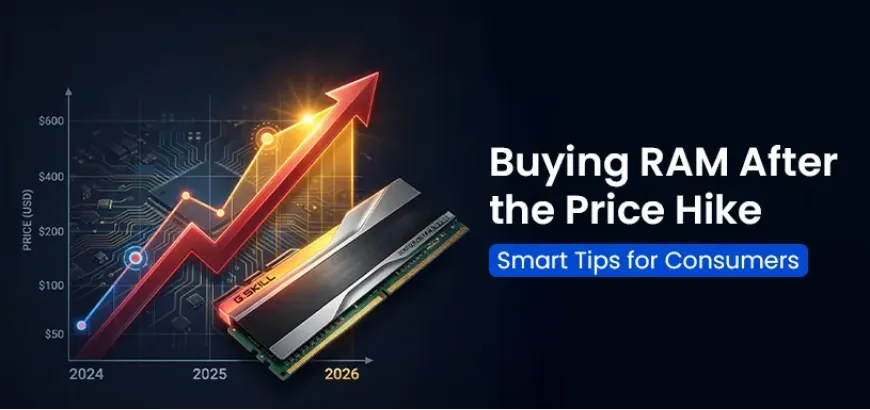
If you are planning to build a gaming PC or upgrade your system in 2026, one of the biggest surprises you will face is the price of RAM. Memory kits that once felt affordable have become shockingly expensive, sometimes costing as much as a mid-range graphics card. While many people casually blame artificial intelligence for this sudden increase, the real story behind the RAM price hike is far more complex.
The rapid expansion of AI, the structure of the DRAM market, and strategic decisions by memory manufacturers have together created a perfect storm that is driving consumer RAM prices higher than ever before.
Table of Contents
- Understanding the Global RAM and DRAM Market
- How the AI Explosion Changed Memory Demand Forever
- Why RAM Is So Important for AI Data Centers
- Server RAM vs Normal RAM: A Simple Explanation
- How Panic Buying Starts and Affects the Market
- Why This Issue Affects Many Devices
- When Will RAM Prices Finally Go Down?
Understanding the Global RAM and DRAM Market
To understand why RAM prices can rise so dramatically, it is important to look at how the DRAM market is structured. Dynamic Random Access Memory, commonly referred to as RAM in consumer devices, is produced almost entirely by three companies: Samsung, SK hynix, and Micron. For many years, this small group of manufacturers managed to keep supply and demand relatively balanced. Production volumes were stable, pricing remained competitive, and consumers benefited from affordable upgrades across PCs, laptops, smartphones, and other devices.
This balance began to break down as artificial intelligence moved from research labs into popular products and services. Suddenly, the same memory that powered consumer electronics became a critical resource for large-scale AI infrastructure.
How the AI Explosion Changed Memory Demand Forever
The rise of AI tools such as ChatGPT, Gemini, and Grok triggered a global race among technology companies to build larger, faster, and more capable AI models. Training and running these models requires large amounts of memory, not just powerful GPUs. AI data centers rely heavily on DRAM to store and process massive datasets at extremely high speeds, making memory one of the most critical components in the AI pipeline.

Because AI companies operate under powerful competitive pressure, they are willing to pay premium prices to secure large quantities of memory as quickly as possible. This overflow of capital shifted the priorities of DRAM manufacturers almost overnight, pulling production away from consumer products and toward enterprise and AI-focused memory.
Why RAM Is So Important for AI Data Centers
In AI workloads, speed is everything. While CPUs handle logic and GPUs handle computation, RAM acts as the fast workspace where active data is stored and accessed. Compared to SSDs, RAM offers dramatically lower latency, making it essential for training large language models efficiently. Although GPUs are often seen as the stars of AI computing, memory availability can become the real bottleneck if it is insufficient.
As AI models grew larger, the demand for high-capacity, high-speed memory exploded. This demand was not temporary or speculative; it was backed by long-term contracts and massive financial commitments, making AI customers far more attractive to memory manufacturers than individual consumers.
Server RAM vs Normal RAM: A Simple Explanation
One common misunderstanding is that AI companies are directly consuming the same RAM modules used in gaming PCs. In reality, data centers use server-grade memory that is designed for maximum reliability rather than raw speed. This memory typically includes Error-Correcting Code, or ECC, which can detect and fix data errors in real time. In a home computer, a minor memory error might cause a crash or slowdown, but in a data center, the same error could damage an AI training run worth millions of dollars.
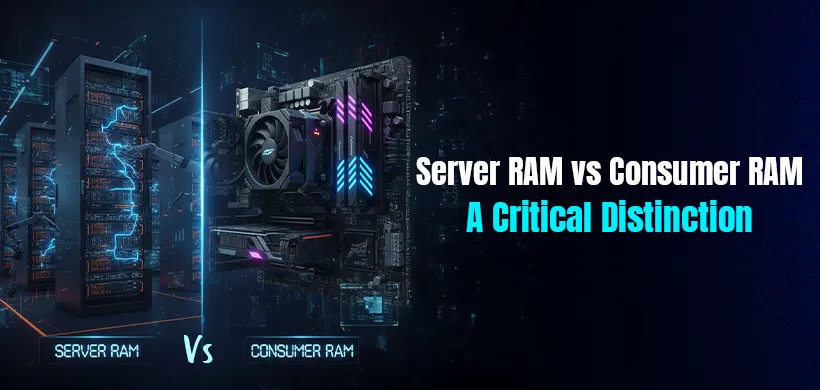
Consumer RAM, on the other hand, is optimized for low latency and high clock speeds, which are crucial for gaming and content creation. While these two types of memory serve different purposes, they are still produced using overlapping manufacturing processes and facilities. When factories shift their output toward server-grade memory, less capacity remains for consumer RAM, regardless of the technical differences between the products.
How Panic Buying Starts and Affects the Market
As RAM prices began rising, emergency buying further intensified the shortage. PC builders rushed to secure memory before prices climbed even higher, while system integrators warned customers of upcoming cost increases. This behavior drained inventory faster than anticipated, reinforcing the perception of scarcity and pushing prices even higher.
Why This Issue Affects Many Devices
The RAM shortage does not stop at desktop computers. DRAM is used in laptops, smartphones, tablets, gaming consoles, vehicles, televisions, and even household appliances. As memory prices rise, manufacturers of these products face higher costs, which are often passed on to consumers. At the same time, flash memory used in SSDs is also being redirected toward enterprise and AI storage, raising concerns about future increases in storage prices as well.
When Will RAM Prices Finally Go Down?
Experts believe that RAM prices will stay high until at least 2028. This is because building new factories takes a long time, and the massive growth of AI is using up most of the supply. For prices to go down, we would need much bigger factories or a drop in interest in AI. While some hope the AI trend will slow down, that could actually cause bigger problems for the rest of the economy.

Final Thoughts: What This Means for Consumers and PC Builders
The increase in RAM prices is not a temporary error but a structural shift driven by AI’s growing influence on the semiconductor industry. As memory manufacturers prioritize high-margin enterprise and data-center demand, everyday consumers and PC builders are facing tighter supply and steadily increasing costs. In this environment, smart planning matters more than ever. For many users, upgrading sooner rather than later may help avoid paying even higher prices in the future.
If you’re planning a new build or an upgrade, Star Tech is the best place to start. As the most trusted computer shop in Bangladesh, Star Tech offers a wide range of original DDR4 and DDR5 RAM from top brands at the best price in BD. Stay connected with Star Tech for the latest RAM prices in BD and make informed upgrade decisions before costs climb further.
Frequently Asked Questions (FAQS)
Q1. Why are RAM prices so high in 2026?
A: RAM prices are high because AI companies are buying massive amounts of DRAM for data centers. Memory manufacturers are prioritizing these high-profit enterprise orders over consumer RAM, which has reduced supply and pushed prices up.
Q2. Is AI really the main reason for the RAM shortage?
A: Yes. The rapid expansion of AI models and data centers has created unbeatable demand for DRAM, powerful existing production capacity, and a pick-up in the consumer market.
Q3. Will laptops and smartphones become more expensive, too?
A: Yes. DRAM is used in laptops, phones, tablets, and many other devices, so rising memory costs are expected to increase prices across consumer electronics.
Q4. Will DDR5 RAM prices go down in 2026?
A: A significant price drop in 2026 is unlikely. Most experts expect RAM prices to remain high until at least 2028 unless AI demand slows dramatically.
Q5. Is emergency buying making the RAM shortage worse?
A: Yes. Emergency buying reduces available stock faster and increases perceived scarcity, which drives prices even higher in the short term.

Comments
There are no comments for this Article.