
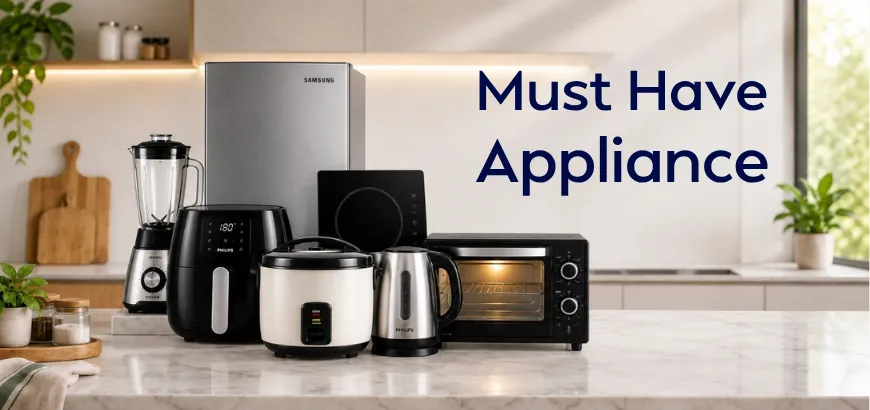
Kitchen appliances have moved from "nice to have" to essential infrastructure in most Bangladeshi households. Rising dual-income families, smaller kitchen footprints in apartments, and frequent gas line disruptions have all pushed buyers toward appliances that cook faster, use less manual effort, and don't depend entirely on a gas stove. This guide breaks down the appliances worth buying first, what specs actually matter when comparing models, and where to find each category in Bangladesh.
1. Refrigerator
A fridge is one of the most important appliances in any modern kitchen because it runs 24/7 and plays a central role in storing vegetables, meat, fish, dairy products, drinks, and leftover food. When comparing refrigerators, pay attention to capacity, energy efficiency, compressor technology, and freezer configuration. A 200–250L single-door refrigerator can work well for a couple or small household, while families of four or more may prefer 300L or larger double-door or side-by-side models with separate freezer compartments.
An inverter compressor can help reduce electricity consumption by adjusting compressor operation according to cooling demand. However, actual energy use varies by model, capacity, temperature settings, usage, and room conditions, so checking the manufacturer's stated energy consumption is more useful than relying on a generic percentage saving.
Frost-free models are worth considering if you don't want to manually defrost the freezer every few weeks. For Bangladeshi kitchens specifically, a dedicated vegetable crisper with humidity control makes a real difference given how often fresh produce is bought and stored short-term rather than frozen.
Buying a refrigerator? See our refrigerator buying guide for help choosing the right capacity, compressor, energy efficiency, features, and configuration.
What to check: Capacity, inverter compressor, energy consumption, frost-free operation, freezer layout, vegetable storage, warranty, and service availability.
2. Rice Cooker
Rice is a daily staple for many Bangladeshi households, making a rice cooker one of the most practical appliances to own. A rice cooker removes the two most common failure points of stovetop rice: burning the bottom layer and misjudging water ratios. Basic models are designed primarily for rice, while more advanced models can include settings for khichuri, porridge, steaming, or other dishes.
Capacity should match the number of people you normally cook for. A 1.5L model can be suitable for a small household, while larger 1.8L–2.8L models are more practical for bigger families or households that regularly cook larger quantities. Pay attention to the quality of the inner pot as well. A durable non-stick coating makes cleaning easier, while a thicker pot can help distribute heat more evenly.
What to check: Capacity, inner-pot quality, cooking modes, keep-warm function, steaming capability, and replacement-pot availability.
3. Electric Kettle
An electric kettle is one of the simplest time-saving appliances for making tea, coffee, hot water, or instant meals. It boils water in roughly 3-4 minutes versus 8-10 minutes on a gas stove. Most household kettles in the 1500-1800W range auto-shut-off the moment water hits a rolling boil, which removes the risk of leaving it unattended.
For most households, a 1.5–1.8L kettle is a practical size. Smaller models are convenient for one or two people, while larger capacities make more sense when several people regularly need hot water. Stainless steel bodies with double-layer, anti-scald exteriors are the safer pick if there are kids at home, since the outer casing stays cool to the touch even while the kettle is boiling.
What to check: Capacity, wattage, automatic shut-off, boil-dry protection, handle design, material, and warranty.
4. Induction Cooker
An induction cooker is one of the most practical backup appliances to own in Bangladesh, given how often gas lines get cut for maintenance or run low on pressure during peak cooking hours. Unlike a gas flame, induction cooktops only heat the pan itself through electromagnetic induction, which means faster heat-up times, no wasted heat warming the surrounding air, and a cooking surface that stays cool enough to wipe down safely right after use.
The catch is that induction cookers only work with ferromagnetic cookware. Cast iron and many stainless-steel pans work, but ordinary aluminum, copper, and glass cookware generally will not unless they have a compatible magnetic base. Most portable induction cookers fall roughly within the 1200W–2100W range. Higher-power models can heat faster but also place a greater load on the electrical circuit, so check the appliance's power requirement and your home's electrical setup before buying.
What to check: Wattage, temperature/power controls, cookware compatibility, safety features, timer, display, and electrical requirements.
5. Air Fryer
The air fryer has become one of the fastest-growing appliance categories in Bangladesh. It is useful for households that frequently prepare fried or roasted foods but want to use significantly less added oil than traditional deep frying. Hot air circulates around the food to create browning and crispness. Depending on the recipe, little or no additional oil may be necessary. Beyond health benefits, it's also considerably faster to clean since there's no oil to strain, cool, and store afterward.
Basket capacity is one of the most important specifications. 2-3L models can work well for one or two people, while 4-5L models are more suitable for many families. Larger 6L+ models make sense if you regularly cook larger portions or want to prepare multiple servings at once. Digital presets can make operation easier for beginners, but they aren't essential. A model with adjustable temperature and time controls can be just as useful once you understand the cooking requirements of different foods.
Not sure which air fryer to buy? Our air fryer buying guide explains capacity, power, cooking modes, basket design, and the features worth considering.
What to check: Basket capacity, temperature range, power rating, basket design, controls, cleaning convenience, and warranty.
6. Microwave or Convection Oven
An oven is particularly useful for reheating food, defrosting frozen ingredients, and quickly heating drinks or prepared meals. In most Bangladeshi kitchens, a microwave-convection combo oven is the practical choice, since it handles quick reheating and defrosting on the microwave function while still offering full baking and grilling through the convection mode, saving both counter space and cost compared to buying two separate appliances.
Capacity depends on how you use the appliance. Around 20L can be sufficient for basic reheating and smaller households, while larger 25–32L+ models provide more room for baking dishes and larger portions. If baking is important, look beyond capacity and check heating consistency, temperature control, rack positions, convection functionality, and available accessories.
Choosing between microwave and convection models? See our oven buying guide for the different types, capacities, cooking functions, and features to look for.
What to check: Type, capacity, power, temperature control, convection mode, grill function, rack positions, and warranty.
7. Blender & Grinder
A blender & grinder covers a wider range of daily kitchen tasks than almost any other appliance on this list. Smoothies, lassi, chutneys, spice grinding, and bhorta pastes all go through the same jar. Motor power matters more here than almost any other spec. Around 500W is fine for liquids and soft fruit, but grinding dry spices, dal, or ice regularly calls for at least 600–750W to avoid overheating the motor.
Multiple jars are particularly useful. A wet jar can be dedicated to liquids and smoothies, while a smaller dry or chutney jar can be used for spices and pastes. This also helps prevent strong smells from transferring between different ingredients. Look for durable stainless steel blades, secure jar locking, easy-to-clean components, and a motor designed for the type of work you expect to do.
What to check: Motor power, jar capacity, number of jars, blade material, speed settings, pulse function, and overload protection.
8. Juicer
A dedicated juicer separates pulp and fiber far more cleanly than trying to force fruit through a regular blender, which is why it's worth the separate purchase if fresh juice is a daily habit rather than an occasional treat. There are two main types: centrifugal juicers, which are faster and cheaper but generate more heat and oxidation (reducing nutrient retention slightly), and cold-press (masticating) juicers, which run slower and quieter but extract more juice per fruit and preserve more nutrients.
For daily use with fruits like oranges or pomegranates, a centrifugal juicer is usually the more practical and affordable starting point; cold-press models are better suited to leafy greens and anyone prioritizing juice quality over speed.
What to check: Juicing method, feed-chute size, pulp container, cleaning requirements, motor power, noise level, and compatible produce.
9. Coffee Maker
A coffee maker is worth the counter space for any household that drinks coffee daily rather than occasionally reaching for instant coffee. Drip coffee makers are the simplest and most practical for everyday brewing. Just add water and ground coffee, and it brews a full pot with minimal effort. Espresso machines are more suitable if you want espresso-based drinks such as lattes and cappuccinos, but they generally require more equipment, technique, and maintenance.
Capacity is usually listed in cups, such as 4-cup, 6-cup, 12-cup. Match it to how many people in the household actually drink coffee rather than buying the largest option by default, since coffee left sitting in a warmer for hours loses flavor.
What to check: Brewing capacity, coffee type, filter system, heating method, controls, cleaning requirements, and availability of replacement filters or parts.
10. Dishwasher
A dishwasher is less essential appliance than a refrigerator or rice cooker, but it can be extremely useful for busy households, especially in apartments where saving time on daily chores is a priority. Dishwashers use a combination of spraying, detergent, heat, and filtration to clean dishes. Beyond convenience, dishwashers typically use less water per wash cycle than hand-washing the same load, since the water is recirculated and filtered rather than run continuously from the tap.
Place settings indicate how many plates, bowls, and utensils fit in a single load. Smaller 6–8 place-setting models can work for compact households, while 12+ place-setting machines are more appropriate for larger families or frequent entertaining. Noise is also worth considering if your kitchen is close to the living or dining area. A quieter model can be noticeably more comfortable in an open-plan apartment.
What to check: Place settings, water consumption, noise level, wash programs, drying system, dimensions, installation requirements, and warranty/service.
How to Prioritize: What to Buy First
You don't need all ten appliances when setting up a new kitchen. The right order depends on your budget and cooking habits. If you're starting from scratch, prioritize appliances based on how essential they are to everyday cooking, not simply the order in which they appear above.
Tier 1: Everyday essentials
1. Refrigerator: For storing fresh and cooked food.
2. Rice cooker: Particularly useful as rice is part of our daily meals.
3. Electric kettle: Convenient for tea, coffee, hot water, and quick meals.
4. Induction cooker: A useful alternative cooking option, particularly when gas supply is unreliable.
Tier 2: Highly useful additions
5. Blender & grinder: Useful for spices, sauces, drinks, chutneys, and pastes.
6. Microwave/convection oven: Especially valuable for reheating and defrosting, with additional baking/grilling capability on suitable models.
7. Air fryer: Worth considering if you regularly prepare fried or roasted foods.
Tier 3: Lifestyle-based appliances
8. Dishwasher: A major convenience upgrade for households that want to reduce time spent washing dishes.
9. Coffee maker: Makes sense for regular coffee drinkers.
10. Juicer: Best for households that regularly prepare fresh juice.
How to Choose Appliances for Your Household
Before buying a kitchen appliance, focus on how often you'll use it, how much space you have, and whether it actually solves a daily problem.
Match it to your cooking habits: A rice cooker and blender may be more useful than a coffee maker if you cook Bengali meals regularly.
Choose the right capacity: Don't pay extra for oversized appliances you rarely fill. Consider your family size and typical portions.
Check kitchen space: Measure your counter, cabinet, and storage space before buying, especially for refrigerators, ovens, and dishwashers.
Consider electricity use: Check wattage and energy-efficiency information, particularly for appliances that run frequently or use heating elements.
Think about reliability and service: For refrigerators, ovens, cookers, and other expensive appliances, warranty coverage, spare parts, and local after-sales service matter.
Prioritize essentials first: Buy appliances that you'll use regularly, then add convenience or specialty appliances as your needs and budget allow.
The best appliance isn't necessarily the most powerful or expensive one; it's the one that fits your household, kitchen, and everyday routine.
Building Your Kitchen the Smart Way
You don't need to buy every appliance on this list at once; start with the essentials that match how you actually cook and eat, then add specialized appliances as your kitchen habits become clearer. If you're outfitting a full kitchen or comparing multiple appliances side by side, browse the complete home appliances collection at Star Tech to compare top brands, specs, and prices in one place.
Frequently Asked Questions (FAQS)
Which kitchen appliance should I buy first for a new apartment?
A refrigerator is usually the first priority because it is essential for safely storing fresh and cooked food. After that, choose appliances based on your cooking habits. A rice cooker, electric kettle, and induction cooker are practical priorities for many Bangladeshi households.
Is an air fryer or a microwave oven more useful for a small kitchen?
An air fryer is better suited to frying-style cooking with less oil, while a microwave-convection oven covers reheating, defrosting, and baking. If counter space is limited, a combo oven generally covers more use cases than an air fryer alone.
Do induction cookers work with all cookware?
No. Induction cooktops only heat ferromagnetic cookware such as cast iron or induction-compatible stainless steel. Aluminum, copper, and glass pots won't work unless they have a magnetic base layer.
How much electricity do kitchen appliances like a fridge or induction cooker use?
It depends on the appliance and how often you use it. A refrigerator operates continuously, so its inverter compressor and stated energy consumption are important for long-term electricity costs. An induction cooker uses more power while operating, but it typically runs for much shorter periods. Check the appliance's wattage and energy-efficiency information when comparing models.

Comments
There are no comments for this Article.