
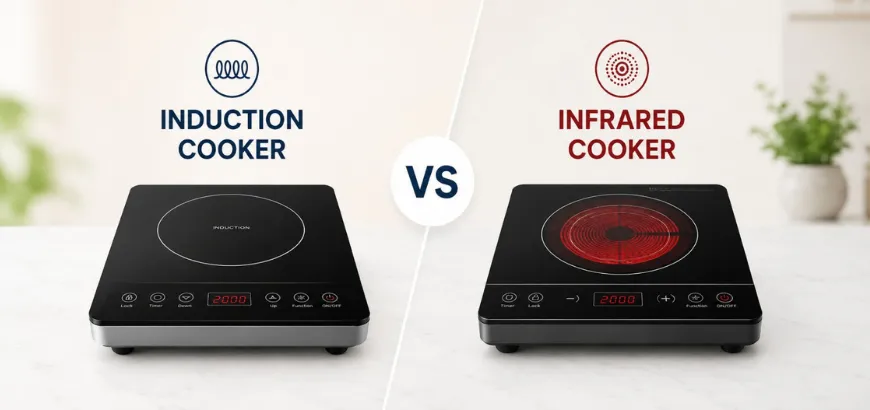
If you're moving away from a gas stove or just want a faster, safer way to cook, you've probably run into two options that look almost identical on the shelf: the induction cooker and the infrared cooker. They're both flat, glass-top, electric cooktops, but the way they actually cook your food is completely different. That difference affects which pots and pans you can use, how quickly you can cook, energy efficiency, surface temperature, and safety.
How They Actually Work
Induction cooker: Underneath the glass surface is a copper coil. When you switch it on, it generates a magnetic field. That field only creates heat when it meets a compatible metal pan, and the pan itself heats up, while the glass surface around it stays cool. No pan, no magnetic reaction, no heat. This is why most induction cookers switch off automatically (or never turn on) if there's nothing on top.
Infrared cooker: There's a heating element under the glass, usually a halogen tube or a ceramic-coated coil that heats up directly, the way an old electric stove coil does. That heat radiates upward through the glass into whatever pan is sitting on top. Because the element and the glass both get hot regardless of what cookware you use, it works with virtually anything: aluminum, cast iron, stainless steel, ceramic, even glass cookware that would never work on induction.
That one mechanical difference “heat the pan directly vs heat the surface, then the pan” is the reason for almost every practical difference between the two.
Induction vs Infrared: Side-by-Side Comparison
| Feature | Induction Cooker | Infrared Cooker |
|---|---|---|
| Heating method | Electromagnetic field heats the pan directly | Radiant heat from an element heats the surface, then the pan |
| Cookware compatibility | Only ferromagnetic cookware (cast iron, stainless steel; most non-induction aluminum/glass/ceramic pans won't work) | Works with almost any cookware: steel, aluminum, glass, ceramic, clay |
| Heating speed | Very fast, heats the pan almost instantly | Fast, but slightly slower since it heats the surface first |
| Energy efficiency | Generally higher (commonly cited around 85%+) since energy goes straight into the pan | Efficient, but somewhat lower than induction since some heat is lost to the surface itself |
| Surface temperature | Cooktop stays cool to the touch; pan gets hot | Cooktop surface gets hot during and shortly after use |
| Safety | Lower burn risk since the glass doesn't heat up | Higher burn risk from the hot surface; needs more care around kids |
| Cleaning | Easy. Cool surface, nothing sticks or burns onto glass | Easy too, though spills can burn onto the hot surface if not wiped quickly |
| Best suited for | Kitchens set up with steel/cast-iron cookware, or willing to switch | Kitchens using mixed or existing cookware, hostels, bachelor setups |
Which One Should You Choose?
Go with an induction cooker if:
You already have, or are willing to buy, induction-compatible cookware.
You want faster heating and boiling.
You want generally better energy efficiency.
You have kids at home and want a cooktop that stays cool to the touch
You're okay with the cooker not working with glass, ceramic, or most aluminum pots
Go with an infrared cooker if:
You want to keep using your existing pots and pans made of glass, clay, ceramic, aluminum, anything
You cook dishes that work particularly well in traditional cookware.
You don't want to replace your cookware just to use an electric cooker.
You don't mind a cooktop surface that gets warm during cooking
You're looking for a slightly more budget-friendly, no-compromise-on-cookware option
For a lot of Bangladeshi kitchens, where clay pots, aluminum handi, and mixed cookware are common, an infrared cooker tends to be the more flexible everyday pick. If you're building a modern kitchen from scratch and don't mind investing in induction-compatible cookware, induction cooker wins on speed, efficiency, and safety.
Browse Induction & Infrared Cookers at Star Tech
Once you've decided which technology suits you, compare the available models based on power rating, cooking zones, controls, safety features, cookware compatibility, warranty, and price. Star Tech's cooker range includes both induction cooker and infrared cooker models, making it possible to compare different models in one place. From portable 1300W–2200W cookers for small kitchens and hostels, to full-glass hobs from Philips, Xiaomi, Tefal, and BOSCH. Prices currently range from about BDT 5,000 to over BDT 3,00,000 depending on brand and features. If you're setting up a full kitchen, it's also worth checking out Star Tech's other home and kitchen appliance categories like Rice Cooker, Pressure Cooker, Oven, Air Fryer, Electric Kettle, Blender & Grinder.
Frequently Asked Questions (FAQS)
Can I use my normal pots on an induction cooker?
Only if they're ferromagnetic. A quick test: if a magnet sticks to the base of your pan, it'll work on induction. Aluminum, glass, and copper pans without a steel base generally won't heat up.
Which one is cheaper to run? Infrared or induction?
Induction cooker is typically more energy-efficient since it heats the pan directly with minimal loss. Infrared cookers use slightly more energy since some heat escapes into the glass surface itself before reaching the pan.
Is an infrared cooker safe to use at home?
Yes, but the cooking surface does get hot during use, so it needs the same care you'd give a traditional stove. Keep children away and let it cool before wiping down.
Can I cook everything on both types?
Functionally, yes! Both can fry, boil, and simmer. The real difference is cookware compatibility and how fast/efficiently they get there, not what dishes you can make.

Comments
There are no comments for this Article.